Shopify is the better fit if you want a fully hosted platform that handles hosting, security, and PCI compliance for a flat monthly fee. WooCommerce is the better fit if you want full code ownership, deeper SEO control, and lower long-term costs on your own WordPress hosting.
Both platforms power a huge share of the world’s online stores, though the exact numbers vary by data source. This guide compares Shopify vs WooCommerce across pricing, ease of use, SEO, dropshipping, security, and scalability, with cited figures throughout, so you can pick the right platform for 2026.
1. Shopify vs WooCommerce: Quick Overview
What Is Shopify?
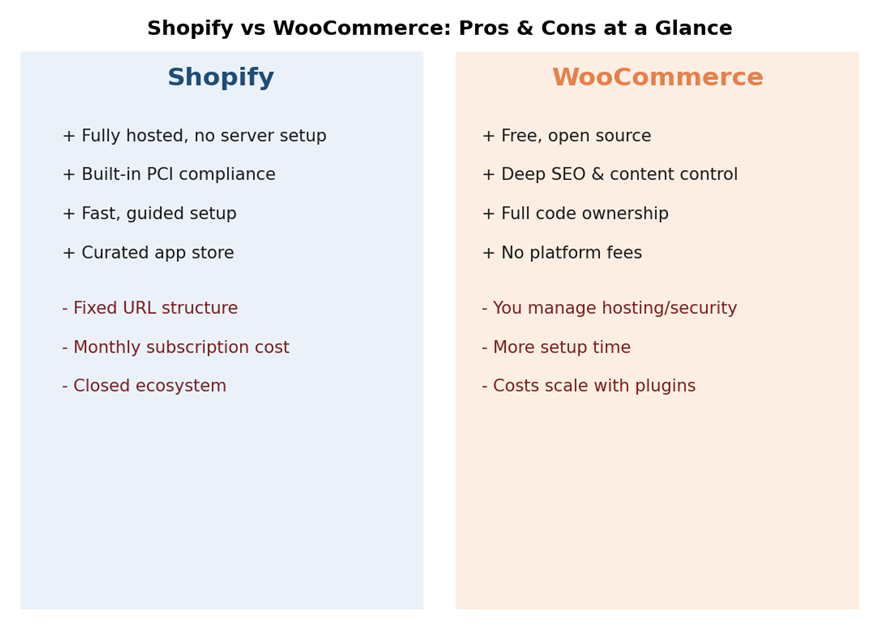
Shopify is a fully hosted SaaS platform. You pay a monthly subscription, and Shopify manages hosting, security, and infrastructure, so there’s no server to configure.
Every plan includes secure commerce hosting and Level 1 PCI DSS compliance by default, according to Shopify’s own pricing page.
What Is WooCommerce?
WooCommerce is a free, open-source plugin that turns a WordPress site into a store, with no licensing fees or revenue-based commissions.
WordPress itself powers roughly 43% of all websites globally, per W3Techs data, which is why WooCommerce and Shopify vs WordPress comparisons often get grouped together.
Shopify vs WooCommerce at a Glance
Here’s how the two platforms compare on the factors that matter most:
| Factor | Shopify | WooCommerce | Best For | Notes |
| Hosting | Fully managed | Self-hosted | Shopify: beginners | Woo needs separate hosting |
| Starting Price | $39/month | $0 plugin + hosting | Woo: tight budgets | Woo scales with plugins |
| Setup Speed | Hours | 1-2 days | Shopify: time-poor | Woo needs more setup steps |
| Transaction Fees | 0% (Shopify Payments) | 0% platform fee | Tie | Gateway fees apply either way |
| SEO Control | Good, fixed URLs | Deeper, full control | Woo: content-led brands | Shopify URLs are not editable |
| Security & PCI | Built in | Your responsibility | Shopify: hands-off | Woo needs SSL and 2FA setup |
| Dropshipping | Faster, real-time sync | Cheaper, slower sync | Shopify: most dropshippers | Woo relies on CRON jobs |
| Scalability | Plus up to $1M+ GMV/mo | Scales with the right setup | Both different paths | Woo needs managed hosting at scale |
2. Shopify vs WooCommerce Pricing
Shopify Pricing Plans
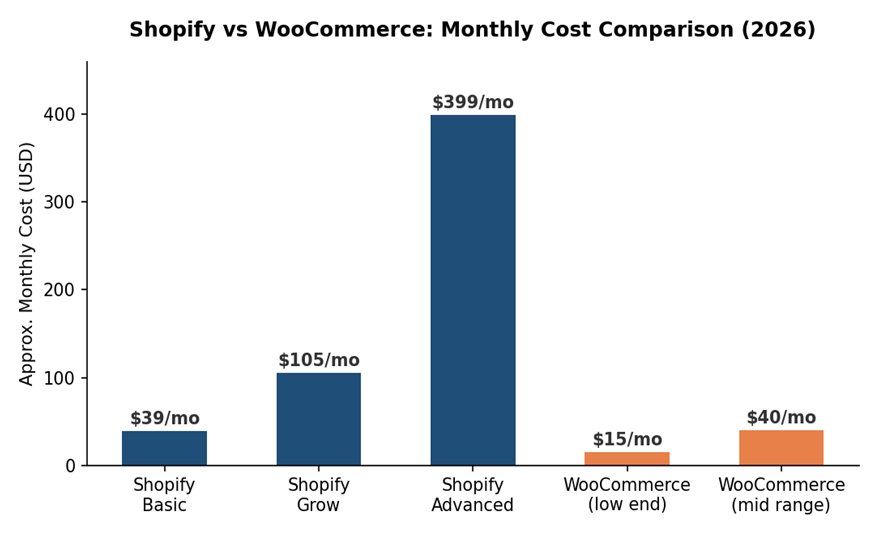
Shopify’s 2026 plans: Basic $39/month, Grow $105/month, Advanced $399/month, and Plus from $2,300/month, according to Shopify’s official pricing page. Annual billing saves roughly 25%.
WooCommerce Costs
The plugin itself is free, but a production-ready store typically costs $1,800 to $3,000+ in year one once hosting, a theme, and plugins are factored in, per WooCommerce’s own cost breakdown. Managed hosting alone runs $11 to $40/month for most growing stores.
Transaction Fees
Shopify charges 0% with Shopify Payments; third-party gateways add 0.2% to 2.0%. WooCommerce charges no platform fee at all, just your payment gateway’s standard rate (e.g., Stripe at 2.9% + $0.30).
3. Ease of Use
Setting Up on Shopify
Shopify’s onboarding is quick and guided, and it offers a free 3-day trial with no credit card required.
Setting Up on WooCommerce
WooCommerce needs a domain, hosting, WordPress, and the plugin set up first, which usually takes 1-2 days for a basic store to go live.
Which Platform Suits Who
WooCommerce suits technically capable teams who want full control. Shopify suits founders who’d rather focus on sales than server management.
4. Design & Customization
Shopify Themes
Shopify’s Basic plan includes 24 free and 1,036 paid themes, built on Liquid, Shopify’s own templating language.
Bay20 builds custom Shopify themes from scratch following Shopify’s development standards, and customizes purchased themes as well.
WooCommerce Themes
WooCommerce’s free Storefront theme is compatible but basic. Premium themes cost $60-$200; a custom build runs $500-$5,000.
Design Freedom
WooCommerce’s open-source code gives full ownership and hosting freedom. Shopify is a closed ecosystem tied to Shopify’s own roadmap.
5. Features & App Ecosystem
App Store vs Plugin Library
Shopify’s App Store has roughly 7,700-8,000 reviewed apps; the average merchant spends $120-$300/month on apps. WooCommerce’s plugin library is far larger but includes abandoned plugins that can pose security risks.
Built-In Features
As of March 2026, every Shopify plan includes Agentic Storefronts and Shopify Magic (AI tools) at no extra cost. WooCommerce needs third-party plugins for comparable AI features, and its native POS was discontinued in February 2026.
6. SEO Comparison
Shopify SEO
Shopify’s 2026 update added native JSON-LD schema for products, reviews, and FAQs. Its main limitation is a fixed URL structure (/products/, /collections/) that can’t be edited without redirects.
WooCommerce SEO
WooCommerce gives full control over meta tags, schema, sitemaps, and URLs via plugins like Yoast SEO and Rank Math, which is why content-heavy, SEO-first brands often prefer it.
Site Speed
Shopify averages a 1.8-second page load out of the box, per independent benchmarking; only about 51% of WooCommerce stores hit sub-second speeds even after optimization.
7. Shopify vs WooCommerce for Dropshipping
Shopify
Shopify’s DSers integration syncs AliExpress orders and tracking in real time. There are reportedly over 4 million Shopify-based dropshipping sites, versus roughly 1 million on WooCommerce.
WooCommerce
WooCommerce dropshipping plugins rely on WordPress CRON jobs, which can delay tracking syncs on lower-spec hosting, though the platform offers lower costs and deeper customization.
The Verdict
Shopify wins on speed and simplicity; WooCommerce wins on cost control and customization for technically capable teams.
8. Security, Hosting & Maintenance
Shopify
Shopify handles hosting, SSL, updates, and security patches automatically, plus built-in CCPA compliance tools.
WooCommerce
WooCommerce store owners are responsible for SSL, security plugins, two-factor authentication, and PCI compliance themselves.
Outdated themes and plugins are a common source of WooCommerce vulnerabilities, which is why ongoing WooCommerce maintenance (updates, security checks, backups) matters for stores that stay on the platform long term.
9. Scalability
Shopify Plus
Shopify Plus covers up to $1,000,000 in monthly GMV before variable fees apply and includes 9-10 expansion stores.
WooCommerce at Scale
WooCommerce can support $10M+ GMV brands with the right architecture (managed hosting, Redis caching, a CDN), though that setup takes real engineering work.
Market Share Snapshot
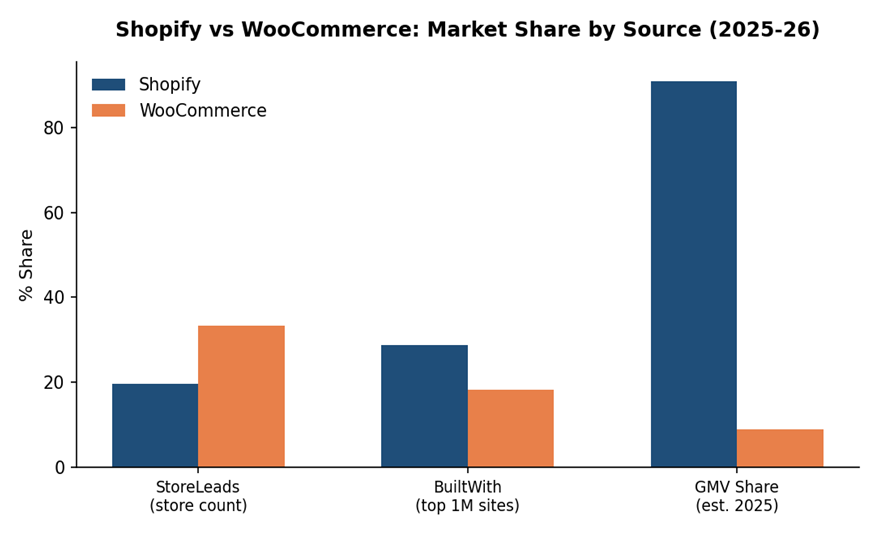
Figures vary by source: StoreLeads puts WooCommerce ahead by raw store count, while Shopify leads decisively in GMV, with roughly $292 billion processed in 2024 per Shopify’s investor reporting, versus an estimated $30-35 billion for WooCommerce.
10. Should I Use Shopify or WooCommerce?
Choose Shopify If…
You want an all-in-one hosted solution and are a beginner or time-poor founder who’d rather not manage a server.
Choose WooCommerce If…
You want deep customization and SEO control and have the technical resources to manage a self-hosted stack.
11. How Bay20 Can Help
Bay20 is a certified development partner for both Shopify and WooCommerce, with 10+ years of experience, 500+ clients served, and 8 verified Clutch reviews citing results like a 500% sales increase for one client.
Whether you need a custom Shopify store built, help migrating to Shopify from another platform, ongoing Shopify SEO support, or WooCommerce development and maintenance, Bay20’s team handles the technical work end-to-end.
12. FAQs: Shopify vs WooCommerce
What is the difference between Shopify and WooCommerce?
Shopify is fully hosted; you pay monthly, and Shopify manages everything technical. WooCommerce is a free plugin on self-hosted WordPress, so you manage hosting, security, and updates yourself. It’s convenience versus control.
Which one is better, Shopify or WooCommerce?
Neither is universally better. Shopify suits simplicity-first merchants; WooCommerce suits merchants who want full control and deeper SEO customization.
Should I use Shopify or WooCommerce for my store?
Choose Shopify if you want hosting and security handled for you. Choose WooCommerce if you already run WordPress and have technical resources available.
Why is WooCommerce better than Shopify for some merchants?
WooCommerce offers deeper SEO control and no platform transaction fees, making it a strong fit for content-driven, SEO-first brands specifically, not a universal advantage.
Is WooCommerce or Shopify better for dropshipping?
Shopify is generally faster and more reliable for most dropshippers in 2026. WooCommerce suits dropshippers who already have an SEO-established WordPress site.
Can I migrate between Shopify and WooCommerce?
Yes, migration is a standard service in both directions, typically handled by an experienced development agency.
References
Shopify pricing: shopify.com/pricing
WordPress market share: w3techs.com
Store count data: storeleads.app
Technology usage data: builtwith.com
WooCommerce cost guide: woocommerce.com
Need help choosing between Shopify and WooCommerce?
Talk with Bay20’s eCommerce experts and get a free platform consultation.